AN-114: Understanding Harmonic Distortion and Signal-Level Interactions in Audio Transformers

By:  Dr. Oliver Gretz

       David Geren, data contributor


This application note examines the fundamental magnetic mechanisms that produce harmonic distortion and dynamic behavior in audio transformers. Understanding these interactions helps designers predict, control, and creatively use transformer non-linearities in professional audio systems.

Fundamentals of Magnetic Core Behavior

The non-linear behavior of an audio transformer originates in the magnetic properties of its core.  These properties are described by the relationship between magnetic flux density and magnetic field strength , commonly represented by the hysteresis loop. Unlike linear materials, ferromagnetic cores exhibit history-dependent magnetization, which gives rise to hysteresis loss, saturation, and level-dependent permeability.

The instantaneous operating point of the core moves continuously along the hysteresis loop as an alternating audio signal is applied.  This movement is directly responsible for harmonic distortion, phase modulation, and dynamic changes in effective inductance.

Flux Density Dependence on Signal Level and Frequency

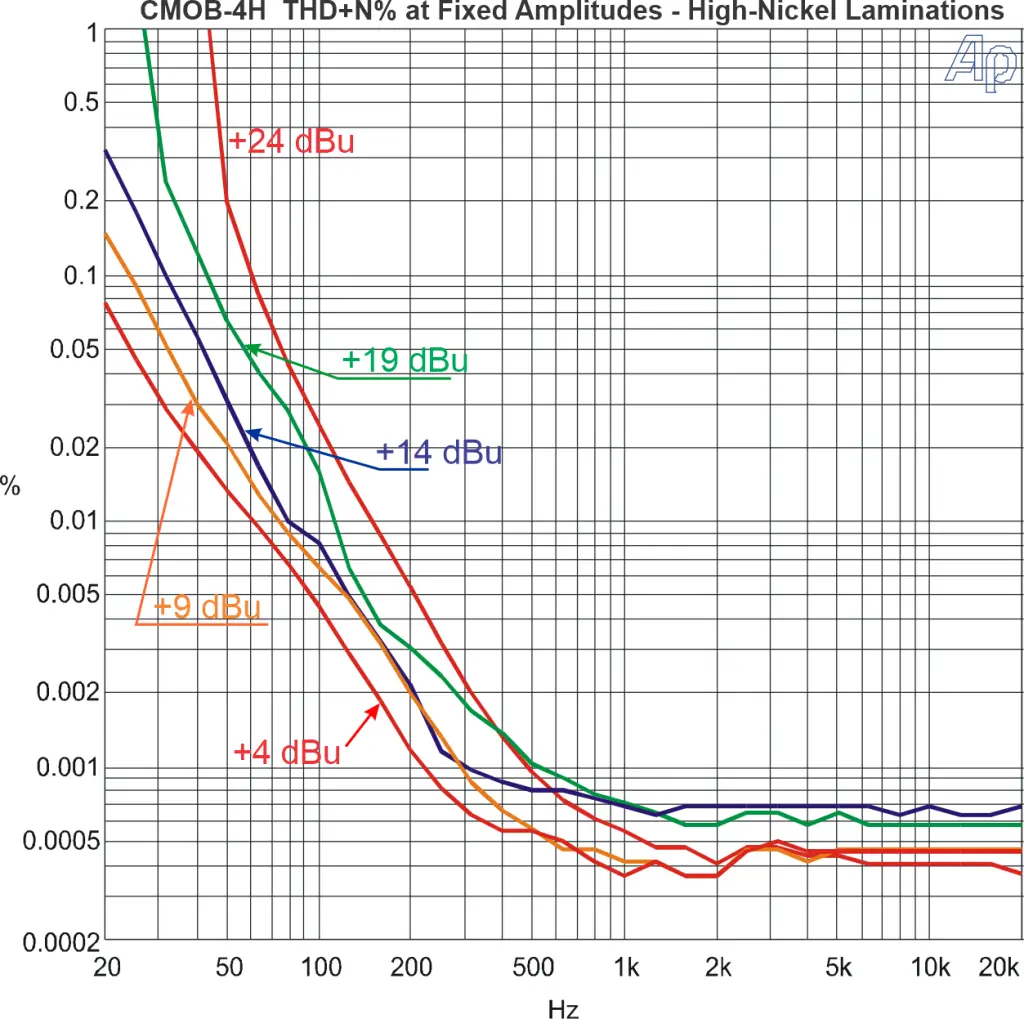
THD+N versus frequency of the CineMag CMOB-4H output transformer.
THD+N versus frequency for the CineMag CMOB-4H output transformer measured at multiple output levels, illustrating how harmonic distortion changes with signal level and frequency.

Fig 1: Total harmonic distortion vs frequency

at different input levels.    Source: CineMag, Inc.

A key relationship governing transformer behavior is the dependence of peak magnetic flux density on applied voltage and frequency. For a sinusoidal excitation, the peak flux density in the core is given by:

Peak magnetic flux density equation for audio transformers.
Peak magnetic flux density equation relating applied voltage, transformer turns, core cross-sectional area, and signal frequency.

This equation shows that flux density is inversely proportional to frequency.  For a constant signal level, low-frequency components generate substantially higher flux density than mid-band or highfrequency components.  As a result, transformer cores are far more likely to approach or enter saturation at low frequencies, even when overall signal levels remain moderate, as can be seen in Figure 1.

This frequency dependence explains why bass signals dominate transformer distortion behavior and why low-frequency transients often trigger audible saturation and compression.

Saturation and Low-Frequency Dominance

As flux density approaches the material’s saturation limit, the transformer’s behavior is governed not by its average magnetic permeability but by its incremental permeability, which describes the local magnetic response at a given operating point on the B–H curve. While average permeability is defined as

transformer operation depends on the instantaneous slope of the magnetization curve, expressed as the incremental permeability

The resulting reduction in inductance, caused by saturation, leads to a sharp rise in magnetizing current, since the primary inductive impedance

decreases correspondingly. This reduction in impedance increases magnetizing current, leading to increased harmonic distortion and dynamic compression. This mechanism explains why saturation effects emerge abruptly and why low-frequency, high-level signals dominate transformer nonlinearity.

Primary Inductance and Source Resistance Interaction

In practical audio circuits, the transformer primary does not operate in isolation. The source resistance driving the transformer interacts with the primary inductance to form a first-order highpass filter. The low-frequency cutoff of this system is given by:

where:

Primary inductance is not constant but varies with signal level due to changes in incremental permeability, as we have seen in the chapter before. As signal level increases and the core moves toward saturation, permeability decreases, reducing . This reduction causes the low-frequency cutoff frequency to rise with signal level.

The result is a level-dependent bass attenuation effect, where strong low-frequency signals are progressively reduced, contributing to perceived punch, tightness, and transient emphasis.

Dependence of Inductance on Magnetic Permeability

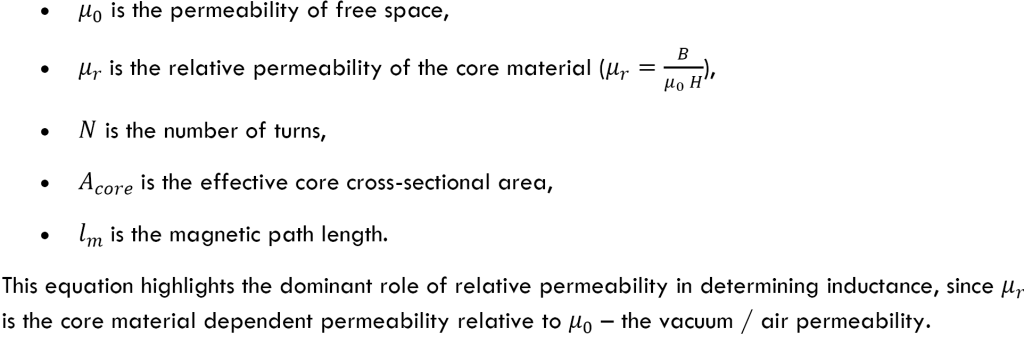
The primary inductance of a transformer is determined by core geometry and magnetic permeability according to:

where:

Nickel Alloy Cores

Nickel-based alloys exhibit very high relative permeability and low coercivity.  This results in large primary inductance values, pushing the low-frequency cutoff well below the audible range.  Permeability remains relatively stable over a wide operating range, minimizing low-level hysteresis distortion and preserving linearity at small signal amplitudes.  However, due to their relatively low saturation flux density, nickel alloy cores reach magnetic saturation at lower signal levels, making them less tolerant of high-level, low-frequency excitation despite their excellent small-signal performance.

Steel and Iron Cores

Silicon steel and iron cores exhibit lower relative permeability and higher coercivity.  The resulting primary inductance is lower, increasing sensitivity to source resistance and raising the low-frequency cutoff.  Additionally, permeability in these materials varies more strongly with magnetic field strength, leading to greater level-dependent inductance changes and more pronounced distortion.  At the same time, steel and iron cores exhibit significantly higher saturation flux density, allowing them to handle higher signal levels before entering saturation, particularly at low frequencies, albeit with increased hysteresis-related coloration.

Level-Dependent Frequency Response and Perceived Sound

THD+N graph of a high-nickel audio transformer.

Figure 2:  Total harmonic distortion vs. input level at different frequencies for a 50% steel, 50% nickel alloy core.  Source: CineMag, Inc.

Because permeability varies with magnetic field strength, primary inductance becomes a dynamic parameter rather than a fixed constant. At very low signal levels, domain friction reduces effective permeability, slightly raising the low-frequency cutoff.  At moderate levels, permeability reaches a maximum, yielding optimal bandwidth.  At high levels, saturation reduces permeability, increasing the cutoff frequency and limiting low-frequency energy.

This same level-dependent behavior of permeability also leads to increased harmonic distortion at the extremes of the operating range as can be seen in Figure 2.  At low signal levels, the total harmonic distortion (THD) in increased, which is associated with domain wall pinning introduced hysteresis-related non-linearity.  At intermediate signal levels the THD decreases.  At high signal levels the collapse of differential permeability near saturation produces strong non-linear magnetization, resulting in rapidly rising harmonic distortion.

Figure 3.  total harmonic distortion vs. input level at different frequencies for all high-nickel alloy core.  Source:  CineMag, Inc.

This low-level increase in distortion is not observed in transformers  employing only high-nickel alloy cores.  As can be seen in this THD vs. Level plot for 80% Ni alloy (custom hydrogen annealed) laminations shown in Figure 3, distortion does not rise at low signal levels but instead remains low or continues to decrease as level is reduced.  This behavior can be attributed to exceptionally low coercivity and high initial permeability of nickel alloys, which allow magnetic domain walls to move with minimal pining even at very small excitation levels.  This results in preserving linear behavior at small signal amplitudes.

This behavior explains why transformer-coupled audio circuits can sound simultaneously warm, controlled, and punchy, despite measurable non-linearities.  

Conclusion

Transformer-induced harmonic distortion arises from fundamental magnetic relationships linking voltage, frequency, permeability, and inductance.  Low-frequency signals dominate these effects due to their disproportionately high flux density demands.  The interaction of source resistance with level dependent primary inductance further shapes the audible response.


Understanding these mechanisms allows audio designers to predict, control, and deliberately exploit transformer behavior, balancing transparency with musically desirable coloration in professional audio systems.

References

[1] R. M. Bozorth, Ferromagnetism. Piscataway, New Jersey, United States: IEEE Magnetics Society, 1993.

[2] J. D. Jackson, Classical Electrodynamics, Third Edition. United States: John Wiley and Sons, 1999.

[3] D. J. Griffiths, Introduction to Electrodynamics, Fifth Edition. United Kingdom: Cambridge University Press, 2023.

[4] A. K. Sawhney, A Course in Electrical Machines, Fifth Edition. Delhi, India: DhanpatRai and Sons, 1984.

[5] W. T. McLyman, Transformer and Inductor Design Handbook, Third Edition. New York, United States: Marcel Dekker Inc., 2004.

[6] D. Self, Small Signal Audio Design, Second Edition. Oxford, United Kingdom: Focal Press, 2015.