

AN-105: RoHS Compliance and Lead-Free Soldering for Audio Transformers
Reduction of Hazardous Substances (RoHS)
European RoHS regulations have required manufacturers to eliminate lead and other hazardous substances from electronic components since 2002. For audio transformers, this shift to lead-free soldering introduces specific technical challenges that must be properly managed to preserve reliability and performance.
Overview of RoHS Regulations and CineMag’s Compliance
In 2002 the European Parliament passed laws binding on members of the European Union that limit hazardous substances in products. These regulations are called Reduction of Hazardous Substances (RoHS). Among the measures affecting the manufacture of electrical transformers is the requirement to eliminate lead (Pb) in solder as well as a number of other substances. These rules can affect reliability unless properly dealt with. CineMag products fully comply with these RoHS standards and have successfully overcome the reliability hurdles they present.
In 2002, the European Parliament promulgated what was the first of a many regulations to drastically reduce or eliminate certain substances which may be hazardous in the environment. They are known as 2002/95/EC or RoHS regulations. RoHS stands for Reduction of Hazardous Substances. These rules severely limit the amount of lead, mercury, cadmium, hexavalent chromium, polybrominated biphenyls (PBB) and polybrominated diphenyl ethers (PBDE) in most products sold in European Union countries. Because of customers’ need to meet these ever-growing environmental regulations, promptly after these regulations were put in force, CineMag converted all production to comply the RoHS standards. Since 2002, there have been numerous additions and changes to the regulations. CineMag continues to meet RoHS standards. The Peoples Republic of China has also created their own version of these environmental regulations, which CineMag also meets.
CineMag will provide written certification of RoHS compliance upon request when purchase orders are placed. Please be sure to specify this in your PO. If your application demands that it not comply with RoHS, typically that lead-containing solders be used, be sure to specify this prominently in your purchase order.
Challenges of Lead-Free Soldering with Transformers
There are a number of significant challenges which you will face if you use a lead-free solder to connect to our transformers and inductors, which you must do in order to maintain the RoHS standard. Use of a solder containing lead will obviously contaminate the product and it will no longer meet the RoHS standards.
i) Lead-free solders work at a much higher temperature than tin-lead solder. One of the challenges is flux choice. Rosin-based flux ceases to be active at the working temperature of lead-free solder. Poor connections can occur.
ii) Transformers with printed circuit pins need to be quickly soldered so that excessive heat is not conducted up the pin to where the transformer windings are connected. This can also soften the area around the pin which usually is thermoplastic. Limit heat time to 5 seconds, after which allow plenty of time for the pin and its internal retaining “rail” to sufficiently cool.
iii) Your RoHS lead-free solder joint may not have the same finish that you get with a lead-solder alloy. If it looks suspect, allow sufficient time for everything to cool before reworking it.
Tin Whisker Risks and Mitigation Strategies
The formation of tin (Sb) whiskers can be a problem in high reliability applications. Exemptions from lead-free standards do exist for certain classifications of equipment.
Generally, because of relatively large geometries and construction methods, transformers themselves should not experience major problems with whisker growth. However, CineMag does not recommend that RoHS compliant transformers be used where maximization of mean time between failures (MTBF) is critical. Whiskers can grow to be many millimeters long. It is a good idea to keep this in mind when designing your product. Use of solder masks on pc boards may have some benefit but the whiskers are capable of undercutting or piercing weak areas in the mask. Keeping tin coated areas well separated as well as conformal coated may be helpful. NASA reports that a number of satellites have failed because of Tin (Sn) whisker phenomena. Note that tin-lead solders significantly reduce or even eliminate this problem, as shown in these NASA photomicrographs.
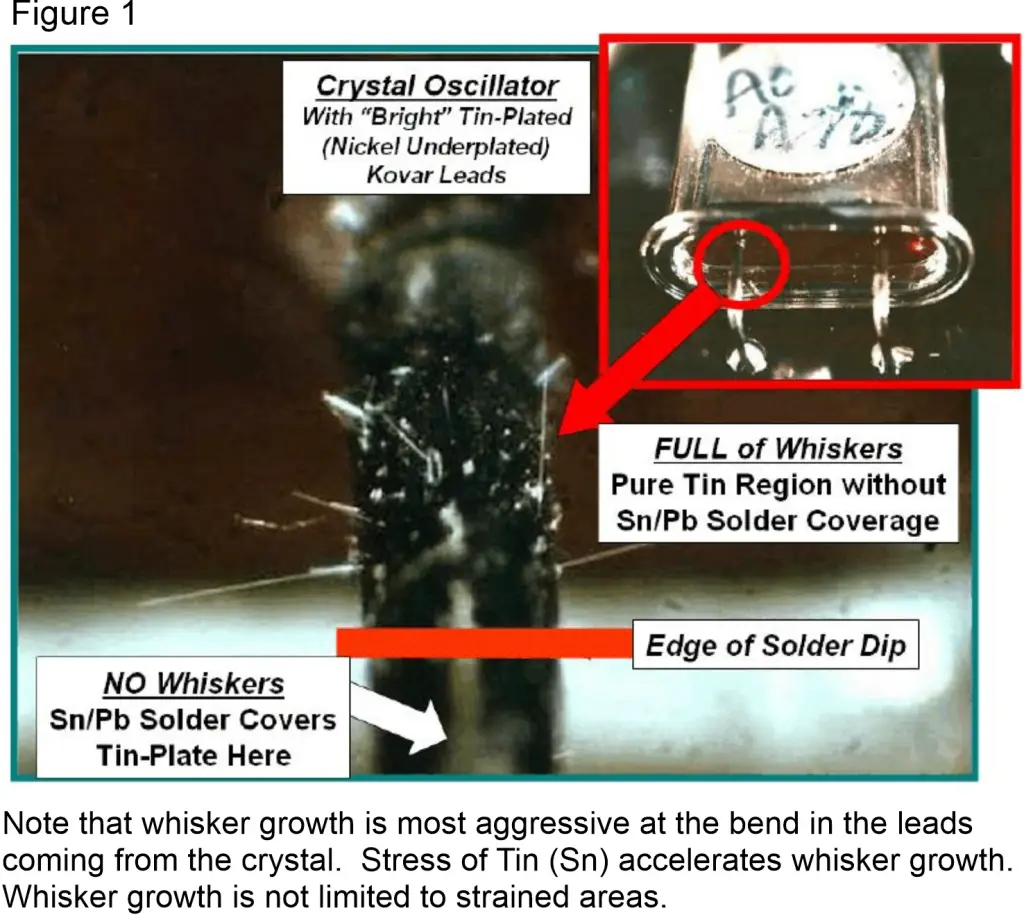
On April 17, 2005, the Millstone Power Station Unit 3 nuclear reactor located in Connecticut was automatically shut down when a tin whisker caused a short on a computer card. This gave the false indication that there was a major steam leak. This failure caused an automatic safe shutdown. It is feasible that a short could have disabled an automatic safety system and contributed to a “significant” reactor failure. Whisker growth is not limited to Sn. Zinc (Zn) whiskers have shut down a major computer center before. Cadmium (Cd) and Silver (Ag) whisker growth in electronics have been well documented. Sn, though, is significantly more prone to developing whiskers.
Research indicates that Sn whiskers seem to erupt as a result of the release of inter-crystalline stresses. RoHS solders typically are an alloy of Sn, Copper (Cu) and Silver (Ag). These solders are more chemically active and dissolve away the Cu wire surface more rapidly that the Lead (Pb) based solders did largely because of the increased soldering temperature. Do not be lulled into complacency because the Sn covered area has been conformal coated. Sn whiskers can undercut or pierce through weaknesses in conformal coatings. The conformal coating may enhance the MTBF rating, but this will not eliminate this failure mode. Sn whiskers will erupt anywhere there is Sn. Strain only accelerates the phenomena.
Work by Boettinger, Johnson, Bendersky, Moon, Williams and Stafford at the NIST in 2005 establish that these stresses result in the eruption of microscopic conical hillocks on the surface of the joint. Out of these hillocks very fine Sn whiskers are extruded. These photomicrographs are of cantilevers upon which a Sn-Cu alloy was electro-deposited and subsequently strained.

Nickel in Mu-Metal and JIG-101 Considerations
CineMag uses mu-metal alloys in most of its transformers as well as all of its shielding cases which are alloys containing a large proportion of Nickel (Ni). While not yet an issue with RoHS, Ni is not approved for extended contact with skin or tissues under the Joint Industry Guide JIG-101, as approved by the JEDEC Board of Directors. Other regulations (REACH) have standards about extended contact with or ingestion of metallic nickel.
David Geren
4487 Ish Drive, Simi Valley, CA 93063
(818) 993-4644
cinemag@cinemag.com
